Why the real AI unlock isn't faster building — it's cheaper, more meaningful validation.
There's a famous line from the 1989 film "Field of Dreams": "If you build it, he will come." The sentiment is seductive: commit to the act of creation, and the rest follows.
It was always a myth. Building something has never guaranteed anyone will care about it. You still need to understand the problem, find the right users, and earn their attention. What has changed — dramatically — is the cost of getting to something real. And that changes how quickly you can find out whether "they" will come at all.
Validation used to require simulation
Traditional product development exists because building was expensive. You couldn't afford to build something real just to find out if the idea held up, so you validated against simulations instead. Users clicked through Figma prototypes. Stakeholders reviewed static screens. Everyone reacted to a representation of the product, and decisions were made on the back of that indirect signal.
It works. But the feedback you get from someone clicking through a mocked-up flow is qualitatively different from the feedback you get when they're using a real, functioning tool. One is opinion about an imagined experience. The other is behaviour in an actual one.
The cost of real just collapsed
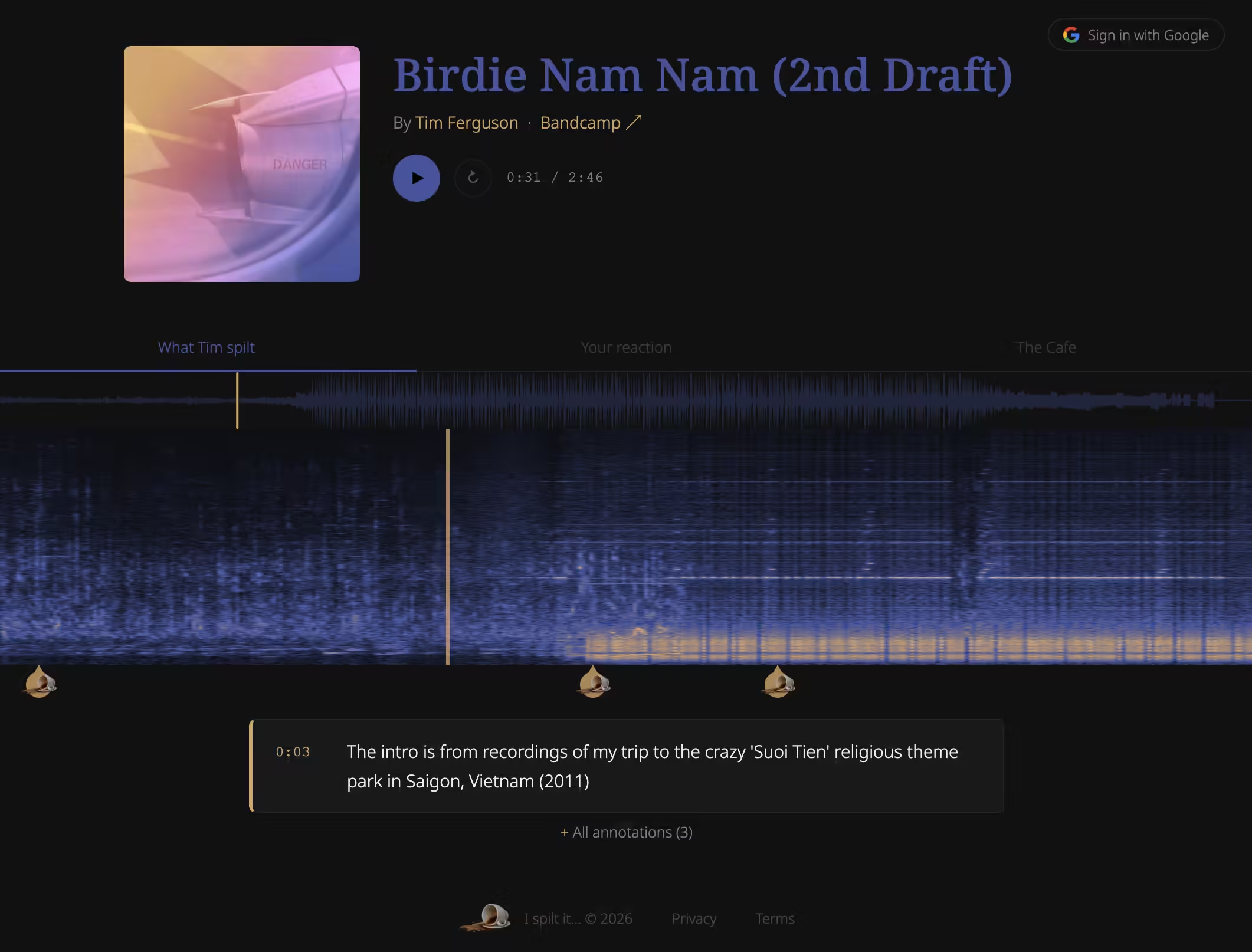
With agentic AI tools, what used to take weeks of development now happens in hours. I've been running a couple of personal projects — one that processes specific communication channels through an LLM to improve signal-to-noise ratio, another an intentional listening platform for experimental music. Both are reasonably complex systems. A year ago, either would have stalled at the prototype stage.
Instead, both went from concept to working product remarkably quickly. Not polished — not finished, but real, functional, and testable with actual users doing actual tasks.
A user actually using a working tool gives you fundamentally richer signal than a user clicking through a simulation. It's the difference between asking someone if they'd buy something and watching them reach for their wallet.
This is the unlock. Not faster building for its own sake, but the ability to put something real in front of people and find out — quickly and cheaply — whether they'll come.
But "they" only come if you've done the thinking
The cost of building may have collapsed, but the cost of building the wrong thing hasn't. You still need to ground yourself in the problem space, do the research, form a hypothesis worth testing. AI agents will build whatever you tell them to — a sycophantic agent will make your half-baked concept sound like a winner. That's on you.
The spec is where your expertise lives. A good spec isn't a feature list — it's a distillation of everything you understand about the problem, the user, and the constraints. It's the document that determines not just whether the thing gets built well, but whether it's worth building at all. If your spec is ambiguous because you don't truly understand the product you're wanting to build, you'll burn through iteration cycles trying to fix what was really a thinking problem, not a building problem. And at the end of it, "they" still won't come — because the foundation was wrong.
On one project where my understanding of the technical constraints and trade-offs was shaky, my spec was vague — I ended up in frustrating refinement loops not achieving the results I was after. On another, where I had a deeper grasp of the domain, the agent built what I wanted first time. Same tool, completely different outcome. The variable wasn't the AI — it was the clarity I brought to the brief. And that clarity came from understanding the problem deeply enough to know what a good solution looked like.
The dream, within reach
"Spec it, and they will come" is closer to reality than it's ever been. The barrier between a validated hypothesis and a working product to test it with has nearly disappeared. You can validate with real products instead of approximations — getting richer signal, faster, with more confidence.
But the phrase only holds true if you earn both halves. The agents will build whatever you spec — that part is essentially solved. Whether "they" come depends on everything you did before you opened the editor: the research, the user understanding, the hard thinking about whether this problem is real and whether your solution actually addresses it.
Get that right, and yes — spec it, and they will come.